

Easy dance hairstyles are all about holding through a routine without a second thought. The trend right now leans into soft face-framing layers and lived-in color, so you can keep a little movement without sacrificing security.
This collection of 30 Easy Dance Hairstyles covers everything from quick five-minute buns to more intricate braided styles, so there is something for every hair texture and length. Whether your hair is fine and falls flat by intermission or you have a fringe that refuses to sit, these styles are built to stay put and still look polished.
Elegant Low Twisted Bun With Pearl Pins
Ever wonder why some buns look like they took an hour when they took ten minutes? This low twisted style starts with collarbone-length, wavy blonde hair with darker roots and highlights, all gathered at the nape and twisted into a neat spiral. A middle parting keeps the front clean, and pearl pins do the securing, which means no visible elastic to fuss with. Ask your stylist for: low twisted bun with pearl pins. It suits medium-density wavy hair and oval or heart-shaped faces, and it holds through a full rehearsal without pulling at the scalp.
Loose Voluminous Bun With Face-Framing Pieces
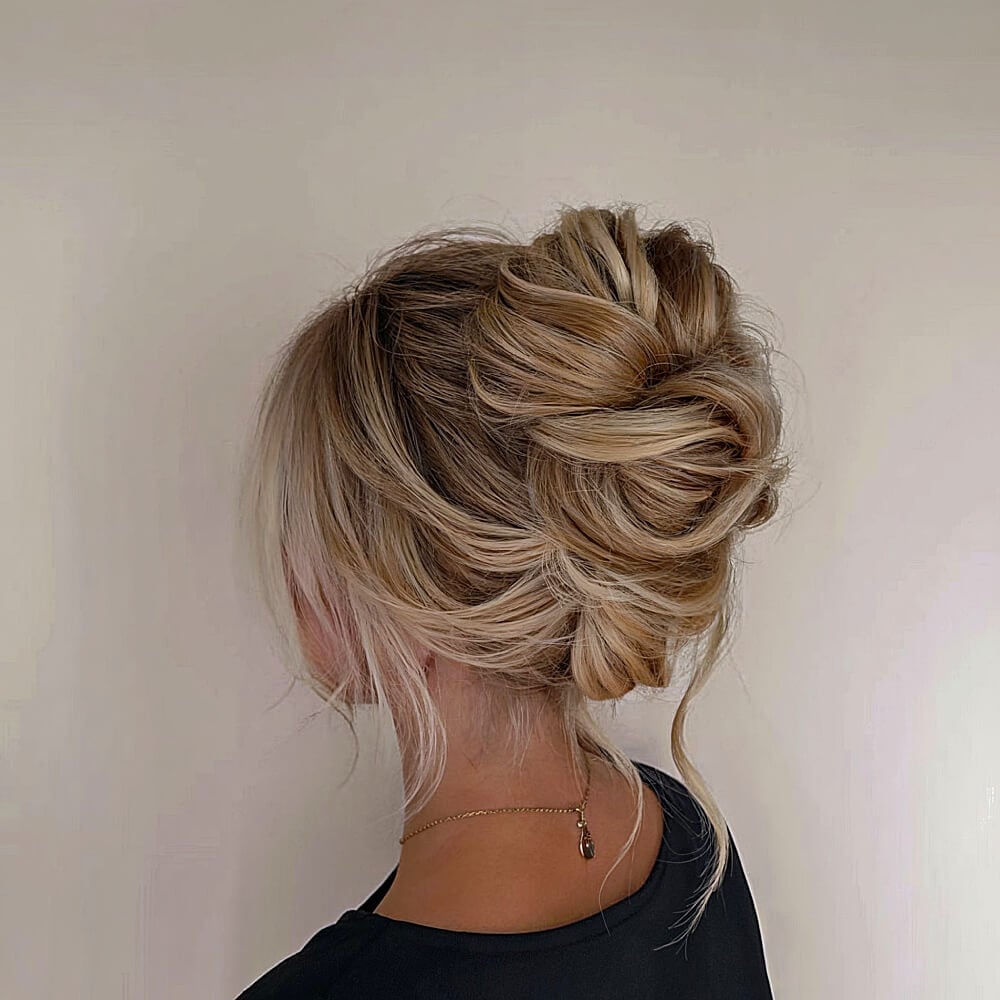
The genius of this bun is how much it does with very little effort. Blonde hair with lighter highlights is swept up into a loose, voluminous shape, but a few face-framing pieces stay out to soften the whole thing. That contrast between the polished bun and the relaxed strands is what keeps it from looking like you tried too hard. Ask your stylist for: loose, voluminous bun with face-framing pieces. It works on medium to thick wavy hair of collarbone length or longer, and it suits most face shapes. Tease the crown slightly before forming the bun for extra height, then set it with a texturizing spray.
High Voluminous Ponytail With Loose Waves
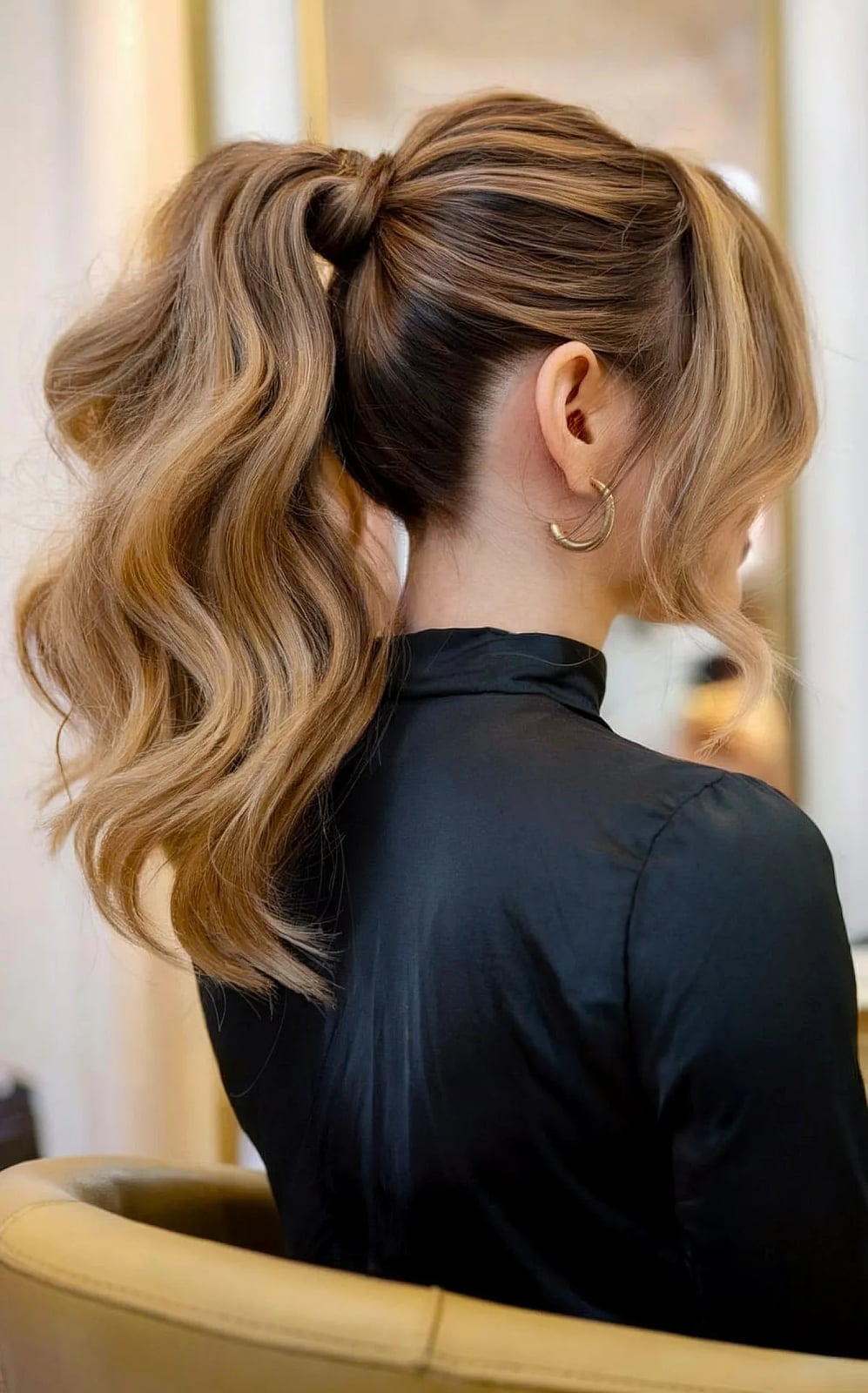
A ponytail this tall does more than keep hair out of your face, it changes the whole silhouette. Thick, wavy collarbone-length hair with blonde balayage is pulled high and styled into loose, bouncy waves that swing with every turn. The side parting adds a little drama, and the volume at the crown gives the style a lift that looks intentional.
This one suits thick, wavy hair of at least collarbone length, and the height helps elongate round faces. Ask your stylist for: high, voluminous ponytail with loose waves. For a performance or a photoshoot, it holds its shape all night with a strong-hold hairspray and a teasing brush at the crown. If your hair is fine or on the shorter side, skip this one, it needs weight to keep the wave pattern.
Voluminous Honey Blonde High Ponytail Curls
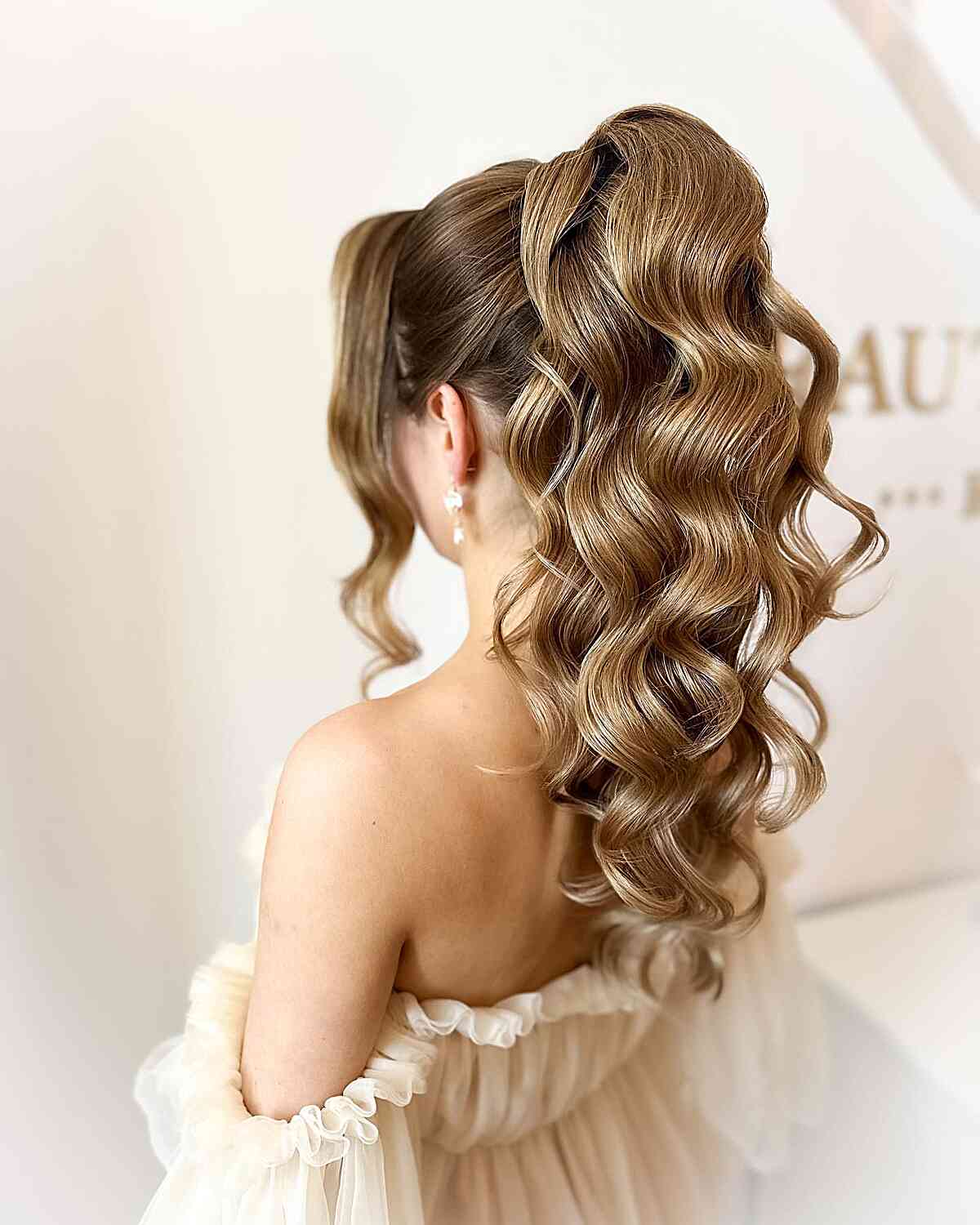
This is the ponytail you build when you want maximum bounce and zero frizz. Thick, wavy honey blonde hair with lighter highlights is pulled into a high ponytail, then each section is curled with a large barrel iron and pinned into place while it cools. That pinning step is what makes the curls last past the first hour, it sets the shape so the bounce holds through a full routine. Ask your colorist for: voluminous high ponytail with bouncy curls. It suits thick, wavy hair of mid-back length or longer, and it works for most face shapes. Doing it at home takes about twenty minutes, but a stylist can finish it in half that time and get a more even curl pattern.
Ash Blonde Voluminous Wavy Ponytail
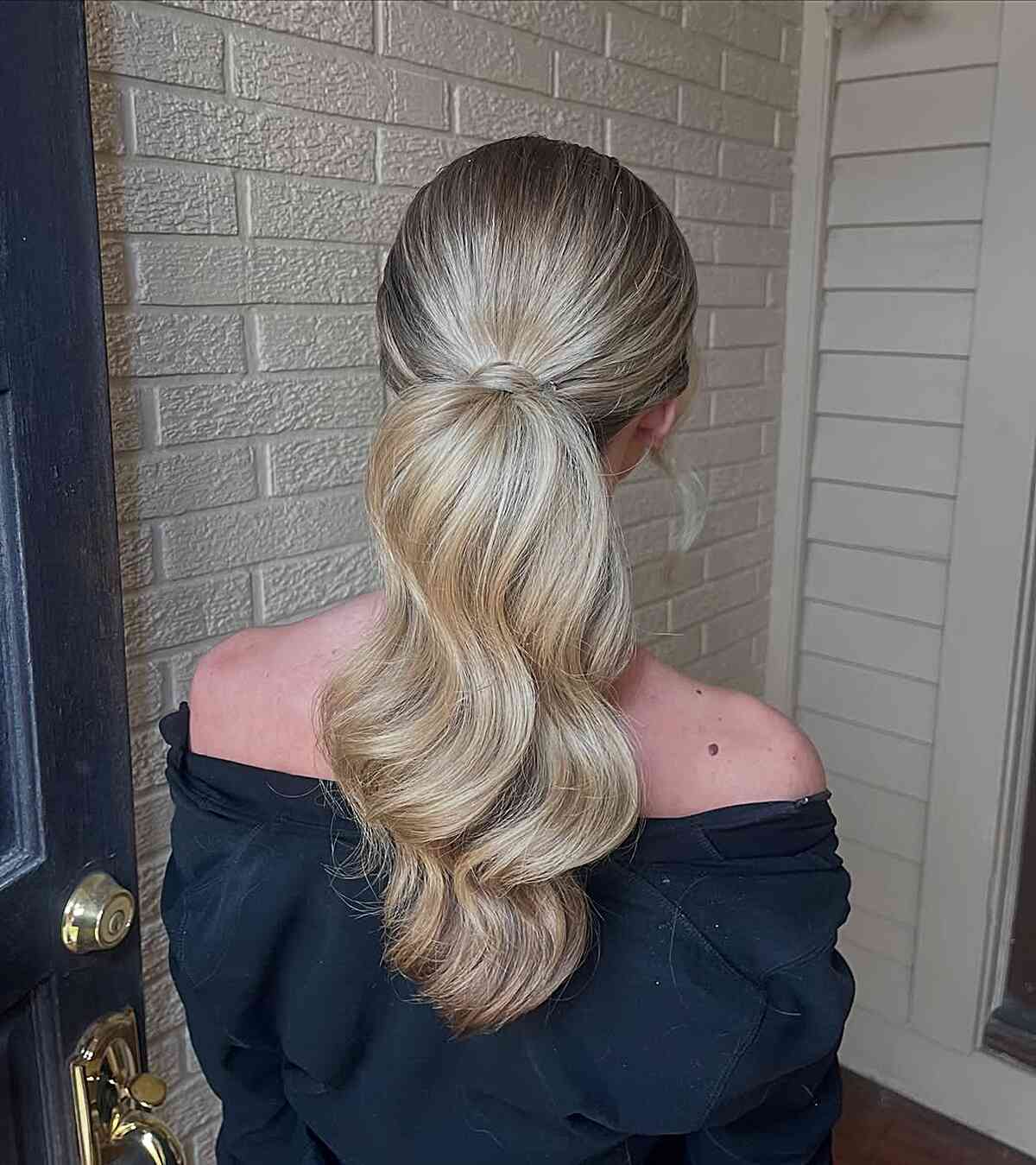
If honey blonde ponytails feel too warm for your taste, this ash blonde version is the cooler counterpoint. The subtle highlights give the waves dimension without the brassiness, and the high ponytail lets the loose, voluminous waves cascade down the back with a polished finish. A small section of hair wraps around the base to hide the elastic, a detail that makes the style look stage-ready. Ask your colorist for: voluminous wavy ponytail with hair-wrapped base. It suits thick, wavy hair of mid-back length or longer and holds well for most face shapes.
The one real drawback is the ash tone itself. Cool blondes fade faster than warm ones, so you will need a toning appointment every four to six weeks to keep the color from turning brassy. For a one-night showcase, the cool, dimensional ponytail photographs beautifully.
Textured Messy Bun With Face-Framing Pieces
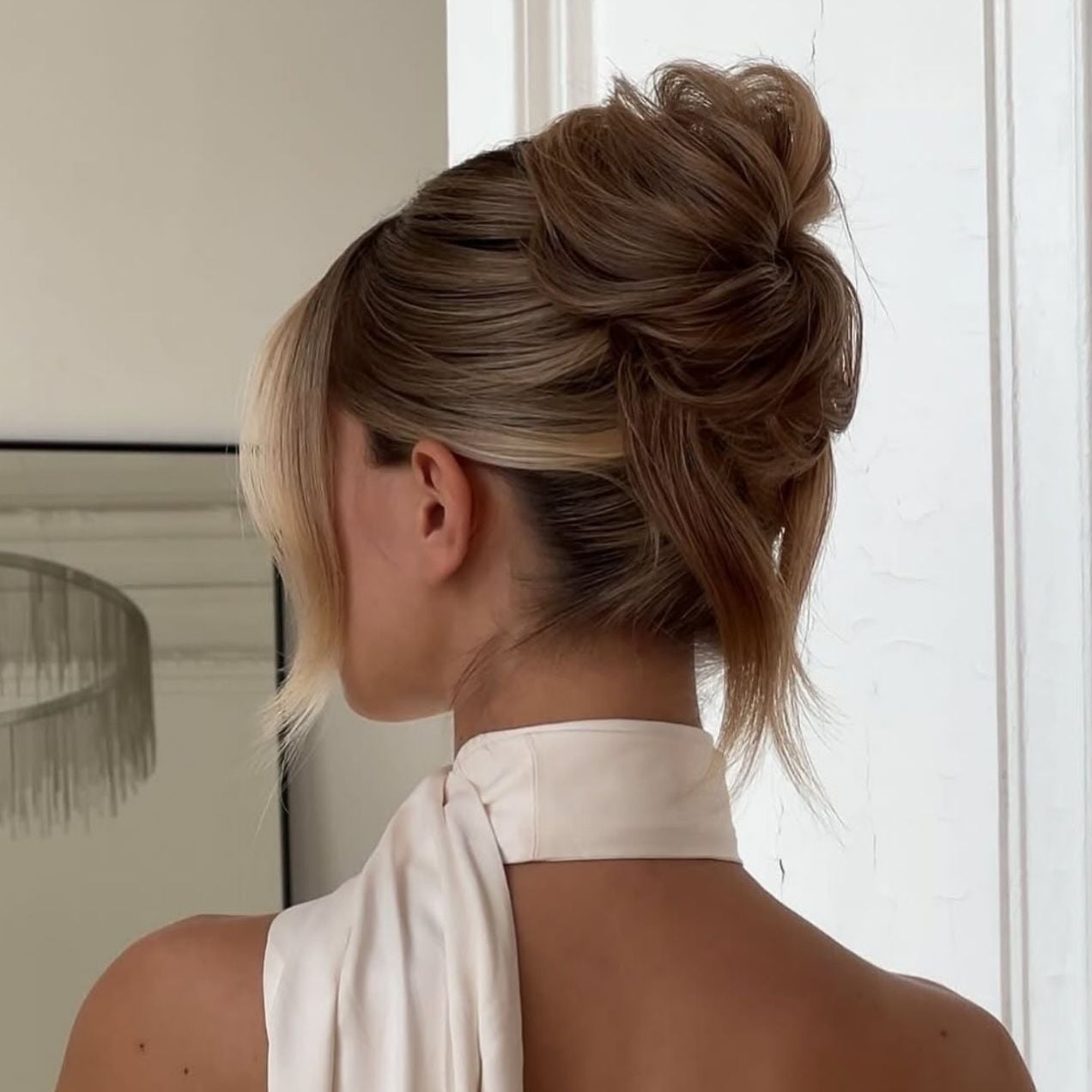
A textured messy bun reads as undone, but the construction is deliberate: ash blonde hair with lighter highlights is gathered and twisted into loose loops at the back, with wavy face-framing pieces left to fall around the ears. This style suits thick, wavy hair at mid-back length or longer, and the soft pieces do the work of softening both square and round faces. Ask your stylist for a textured messy bun with face-framing pieces. After securing the bun, pull out a few strands around the crown and nape; the slightly chaotic finish holds better than a polished one, since the hair has more surface tension against the pins.
Messy Updo With Braided Accents And Pearls
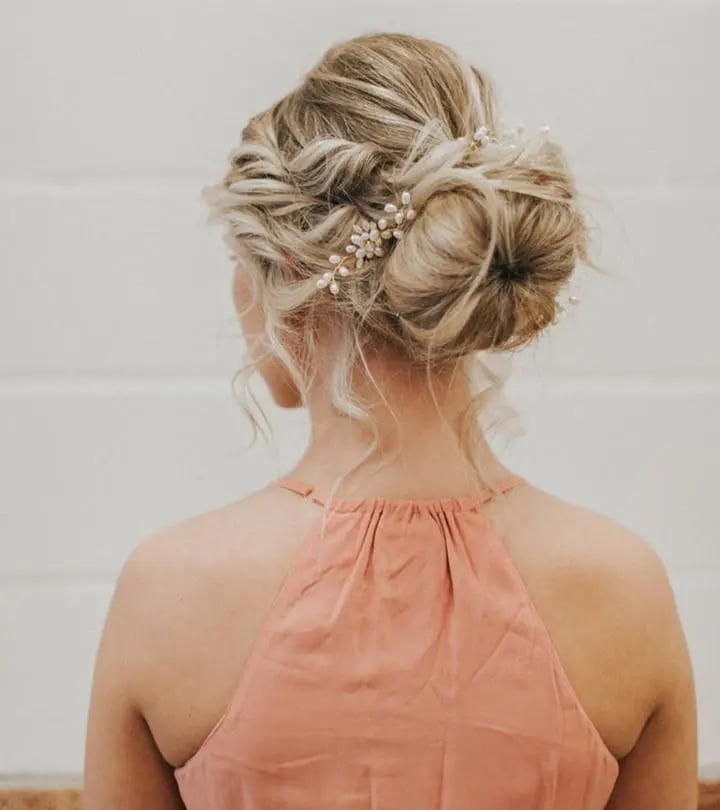
How do you ask for an updo that looks intricate without being fussy? Start with the visible details: mid-back length blonde hair with lighter highlights and a messy updo that tucks in small braids and pearl pins. Ask your stylist for a messy updo with braided accents and pearl pins. Be specific about placement: you want the braids woven through the sides so they anchor the style, and the pins scattered where the hair is thickest, not all at the top. This is a performance or formal occasion style for thick, wavy hair. The messiness adds width at the crown, and the loose pieces break up the line, so it works with a range of face shapes.
Blonde Twisted Bun With Intricate Detail
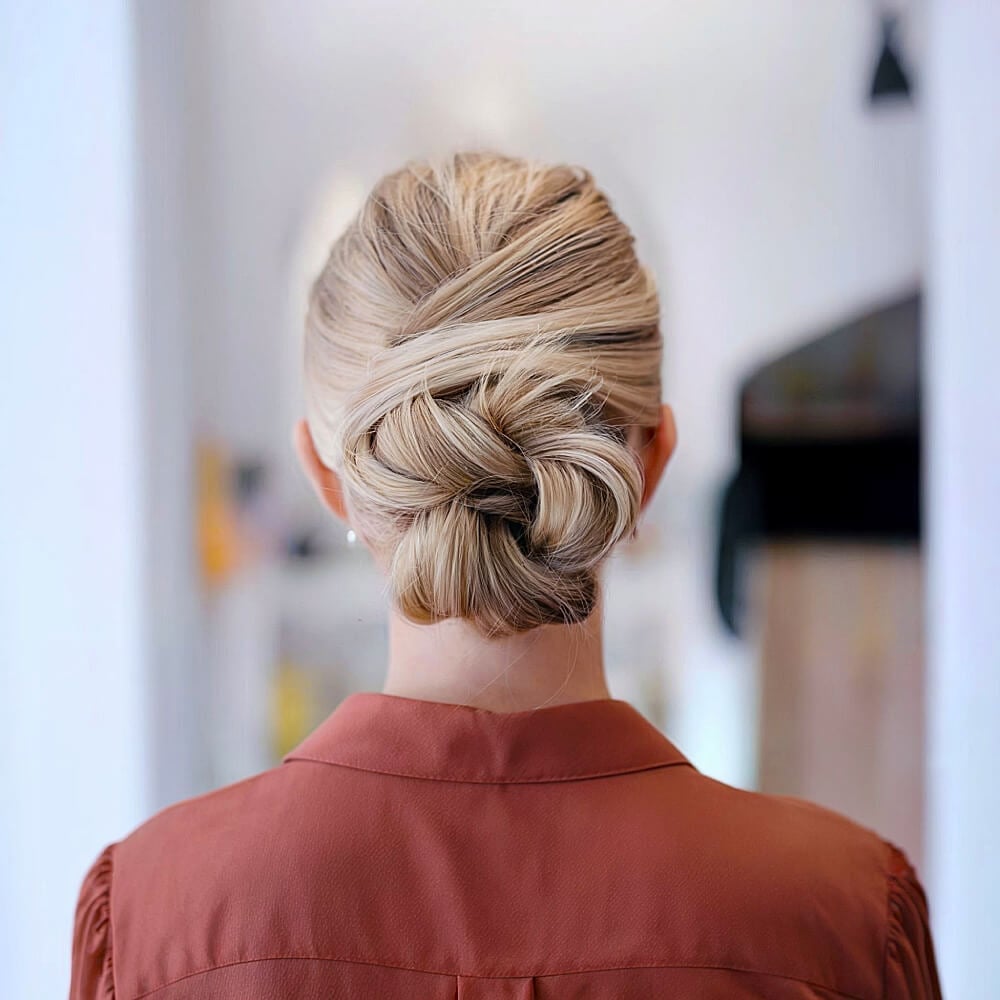
The trick to a twisted bun is that it is built from sections, not one roll. Blonde, wavy hair is parted in the middle, then each side is twisted tightly and coiled around the base at the nape, creating a layered rope effect. Ask your stylist for an intricate twisted bun. This works on medium density, wavy hair from collarbone length up. The pins are the challenge: with multiple coils, you need enough of them to hold each twist flat, and a strong hold spray is required or the outer loops will loosen within an hour of dancing.
Dark Brown Rolled Updo With Face-Framing Pieces
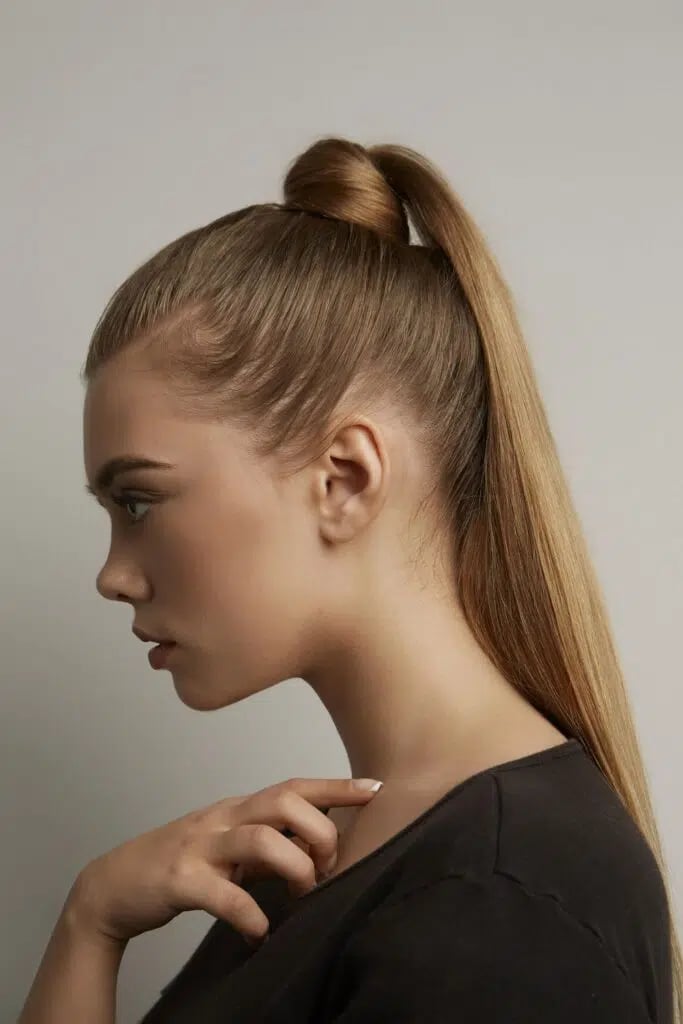
A soft roll at the nape is one of the few updos that genuinely flatters an angular jawline, because the eye is drawn upward and the loose pieces around the face break the line of the chin. The dark brown, thick, wavy hair is rolled upward from the ends to the crown and pinned, with a side parting and face-framing pieces left out. Ask your stylist for a soft rolled updo with face-framing pieces. This is best on collarbone length or longer hair, since the roll needs enough weight to sit smoothly. If your hair is fine, the roll can look flat; ask for a little backcombing at the crown before the roll to keep it from collapsing.
Honey Blonde Braided Bun Updo
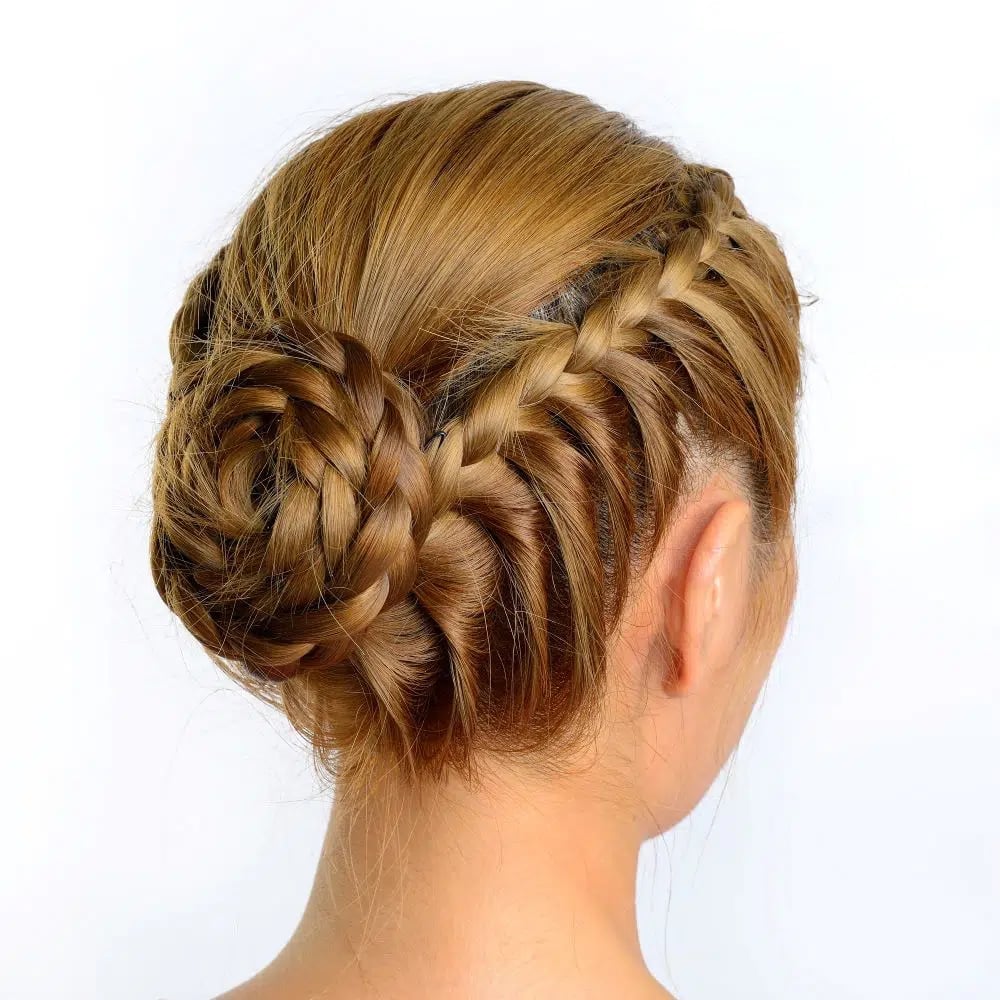
Compared to a plain twisted bun, a braided bun adds visible texture and a more polished line, but it also costs more time. Here, thick, straight honey blonde hair is braided from the nape, then coiled into a bun and pinned flat. Ask your stylist for an intricate braided bun. This is a salon-level style, not a quick DIY, because the braid needs to be even and the coil has to sit centered. Mid-back length hair is the minimum to get a bun with real volume; shorter hair will read as a small knot. The payoff is a hold that stays put through a full routine, since the braid locks the hair into place.
Smooth Dark Brown Bun
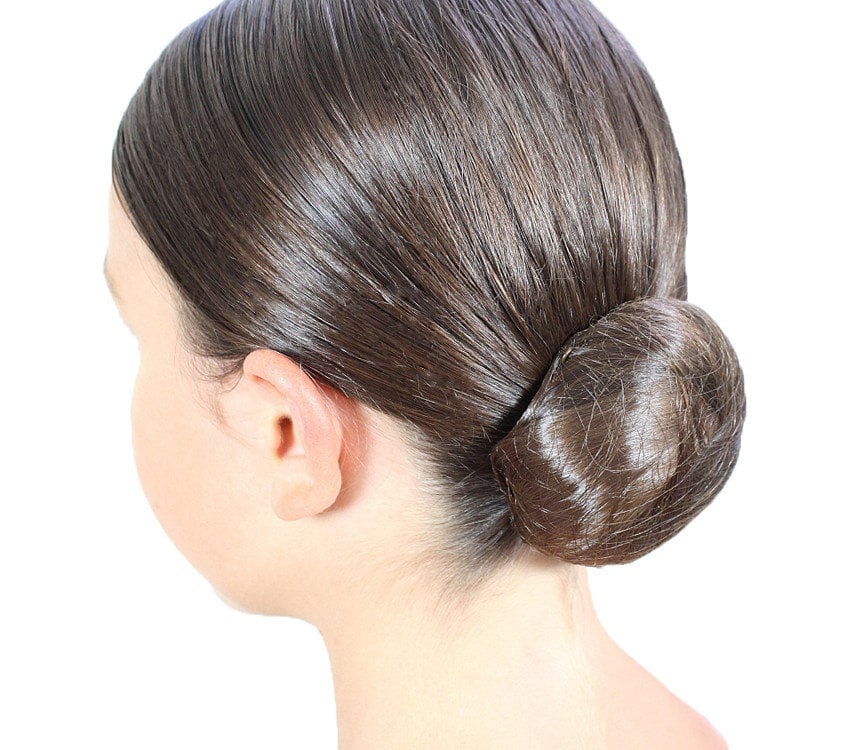
A smooth bun at the back of the head is the dance-world equivalent of a tailored suit: it never argues with you. On straight, medium-density dark brown hair of mid-back length, the style reads as polished without demanding a single bobby pin’s worth of fuss. Ask your stylist for a smooth, neat bun. The hold comes from the sleek finish, so a boar bristle brush to sweep strands flat before twisting is the only tool you need. It stays put through a full rehearsal, and the low maintenance extends to grow-out: no layers to chase, no bangs to train. A trim every eight weeks keeps the ends clean enough for the bun to sit tight.
Because the hair is pulled back completely, the style works for every face shape. The side view shows how the bun sits low, which keeps the silhouette quiet and elegant. It is the sort of style that looks like you planned it, when really it took four minutes and one elastic.
Dark Brown Twisted Updo With Side-Swept Bangs
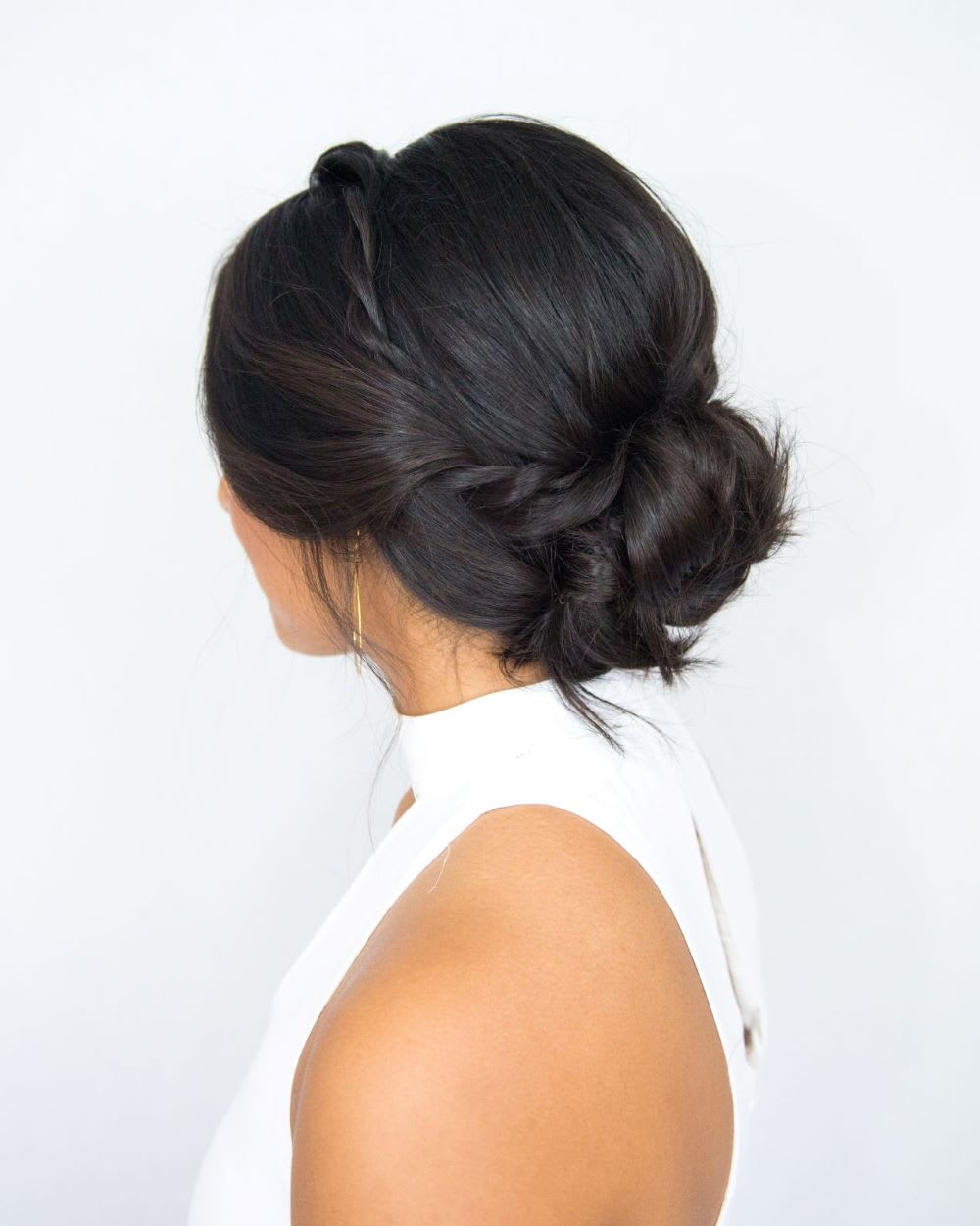
How do you ask for an updo that looks intricate but holds through a fast number? Say you want a low twisted updo with side-swept bangs and a side parting. On thick, straight dark brown hair at shoulder length, the twist sections are pinned tightly to create texture, while the side-swept bangs break up the severity of the style and soften a square jaw. Ask your stylist for a low twisted updo with side-swept bangs. The one real drawback: the twist can loosen if the hair is too silky, so a texture spray at the roots before twisting gives the pins something to grip. The side parting means the bangs need a quick re-sweep after any vigorous head movement, but the bun itself stays anchored.
Sleek High Black Ponytail With Baby Hairs
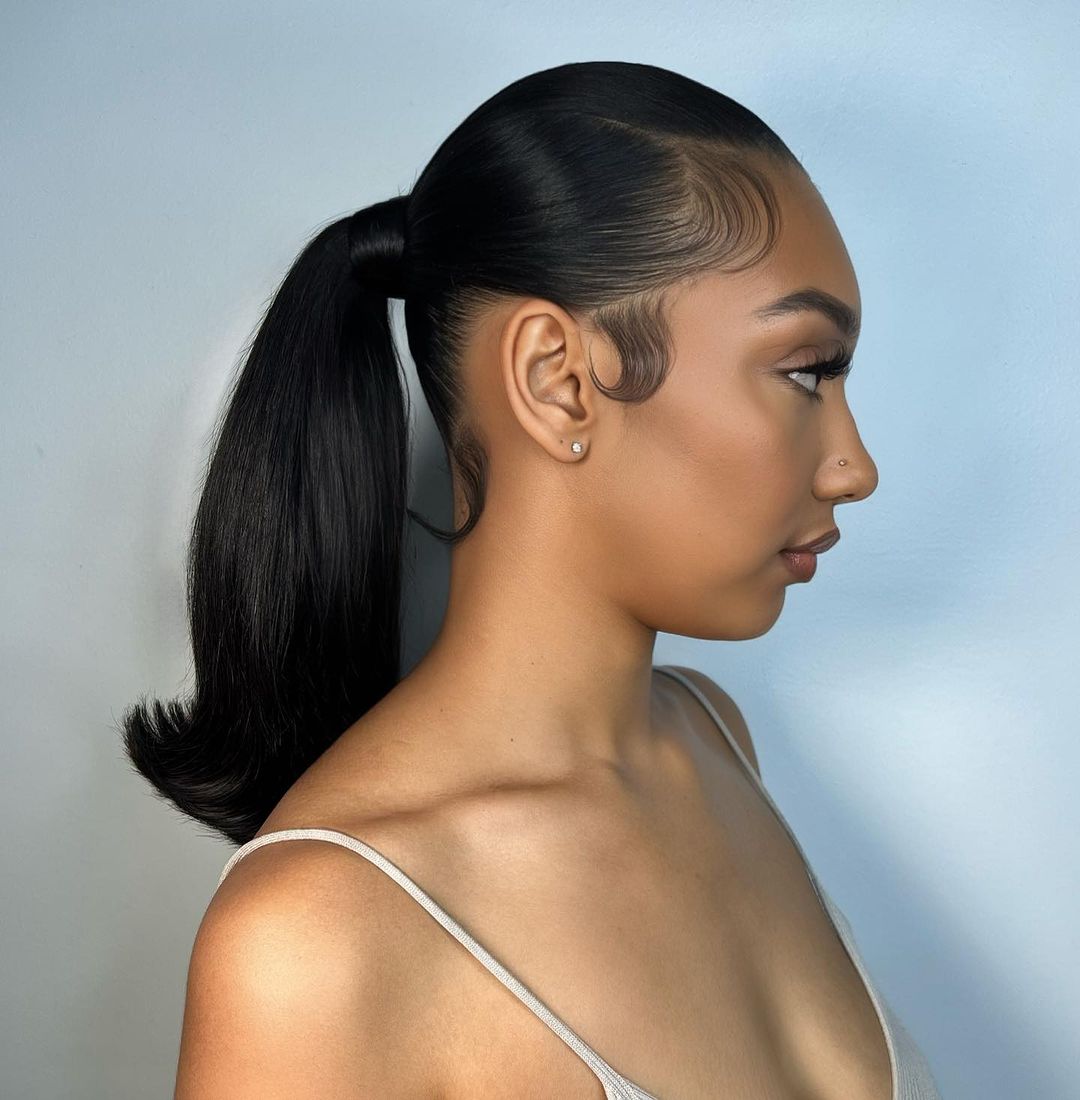
A high ponytail is only as sharp as its edges, and this one has edges that could cut glass. The black hair is pulled up to mid-back length, with baby hairs styled into deliberate swirls along the hairline. The middle parting keeps the front symmetrical, which makes the slicked-back finish feel architectural rather than hurried. Ask your stylist for a sleek high ponytail with styled baby hairs. Getting the look at home means a strong-hold gel or pomade, a fine-tooth comb, and about ten minutes of patience to lay every flyaway flat. Doing it yourself is possible, but the salon version wins on precision: a stylist will map the baby hairs into a pattern that survives a full routine. The hold is excellent, though the gel will need a refresh if you sweat heavily.
Thick Black Bubble Ponytail With Ribbons
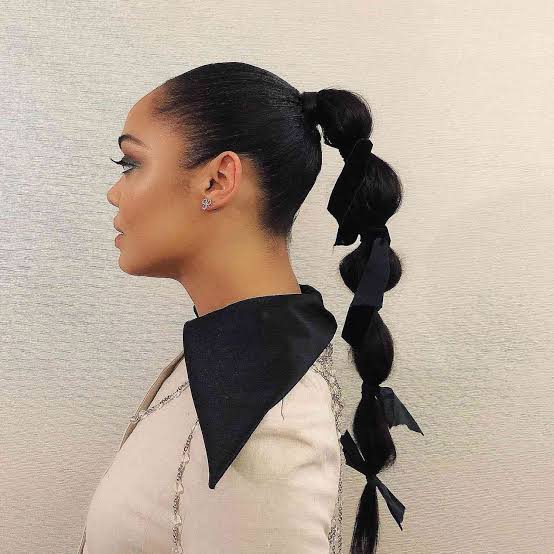
Compared with a standard ponytail, which just hangs there, a bubble ponytail gives the hair a rhythm of its own. The thick, straight black hair is sectioned into rounded bubbles down to mid-back, with black ribbons tied at each interval. The slicked-back front keeps the style from tipping into costume territory, which is the risk with any ribbon moment. Ask your stylist for a bubble ponytail with black ribbons. Clear elastics create the segments, then the ribbons wrap each join for a finished edge. The visual difference is the point: a plain ponytail reads as practical, while this one reads as a choice. It suits thick hair best, since the bubbles need volume to hold their shape, and it lasts through a long performance without sagging.
High Braided Ponytail Black Hair
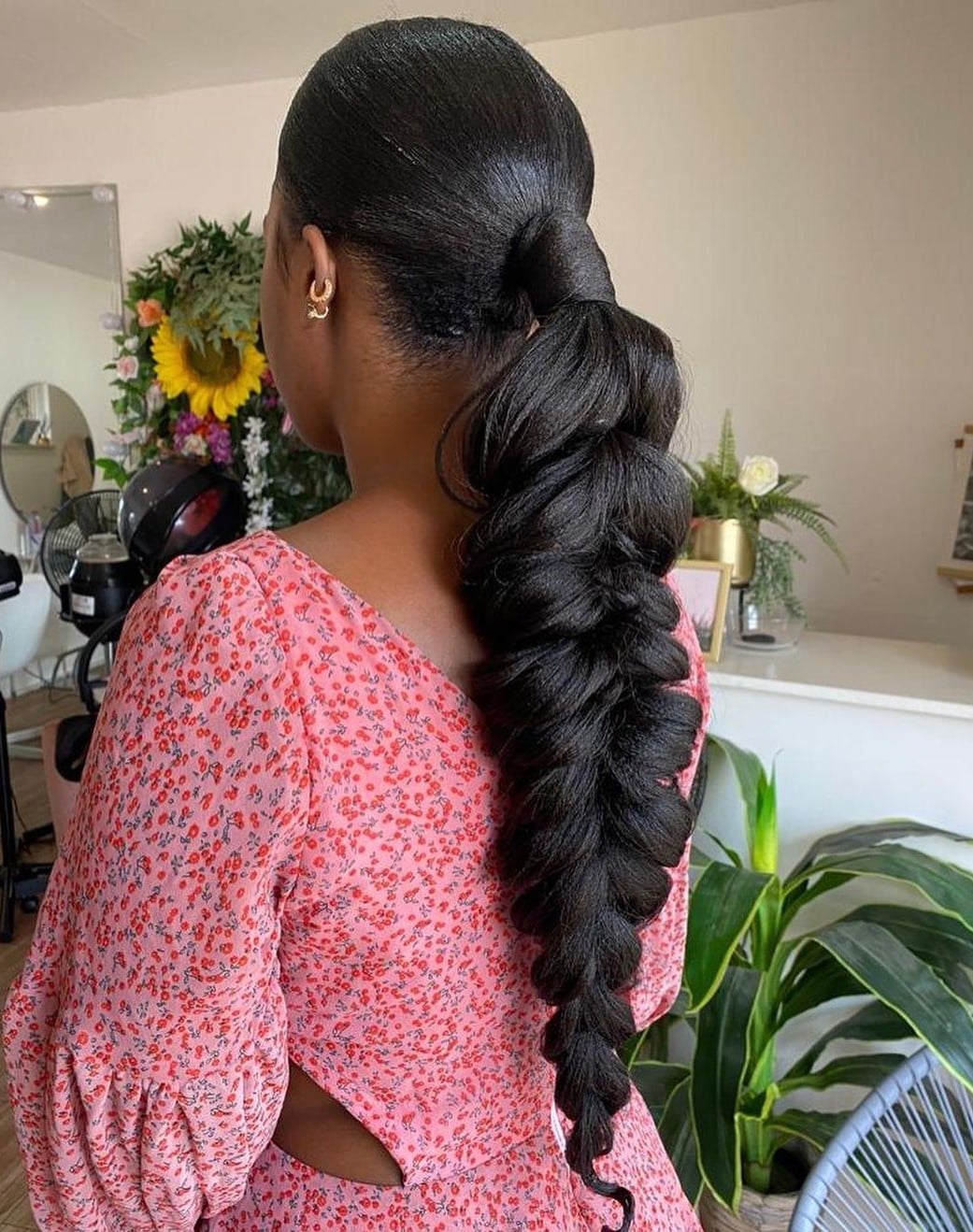
Thick hair is the quiet advantage here, because a braid is only as voluminous as the strands feeding it. The black hair, parted in the middle, is pulled into a high ponytail at mid-back length and braided from the base, so the whole structure appears as one solid column. Ask your stylist for a voluminous high braided ponytail. The thickness of the hair does the work: a finer texture would produce a slimmer braid that still holds, but it would not carry the same presence. The high placement keeps the weight off the neck, which matters during long rehearsals, and the tight braid locks the style in place for hours. The height and middle parting balance the proportions without hiding anything.
Intricate Dutch Braid Dark Brown Hair
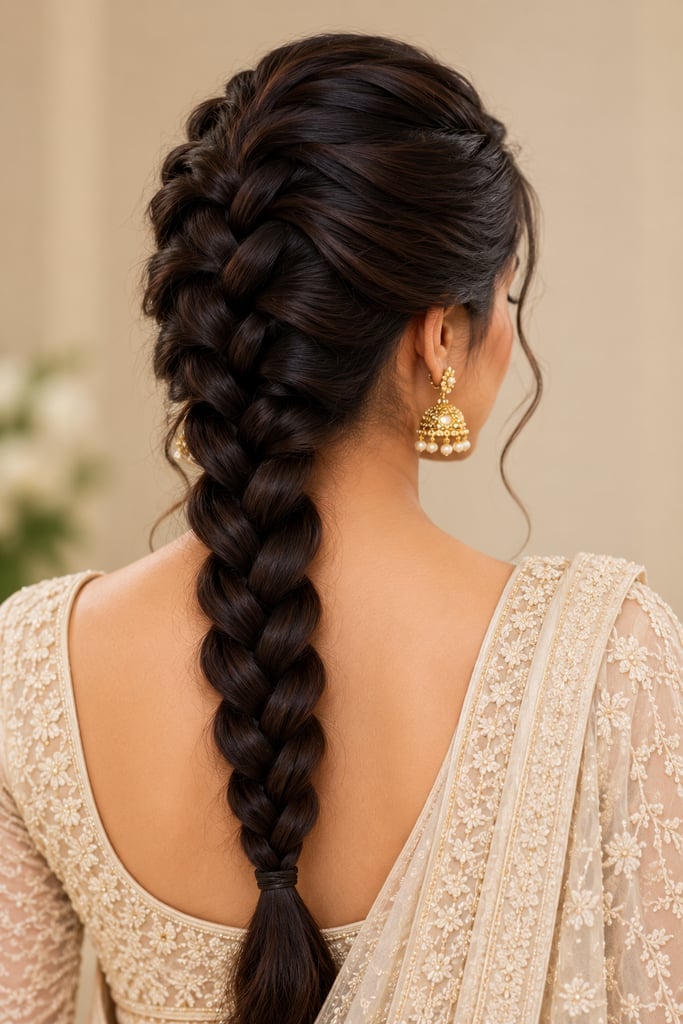
The defining feature of this style is the raised, rope-like pattern that comes from crossing strands under, not over, the center section. It’s a technique that reads as more dimensional than a standard French braid, and the thick, straight dark brown texture here shows off every twist. Ask your stylist for: intricate Dutch braid. Starting at the crown, the braid is built by adding hair from the sides as you work down to the nape, then continuing to the ends. It takes about twenty minutes to execute properly, and a salon is the safer bet if you want the pattern even on both sides. The one drawback? The tighter you pull, the longer it holds, but a snug braid on straight hair can feel heavy by the end of a long rehearsal. Mid-back length or longer gives the braid enough weight to sit smoothly.
Dark Brown Fishtail Braid With Highlights
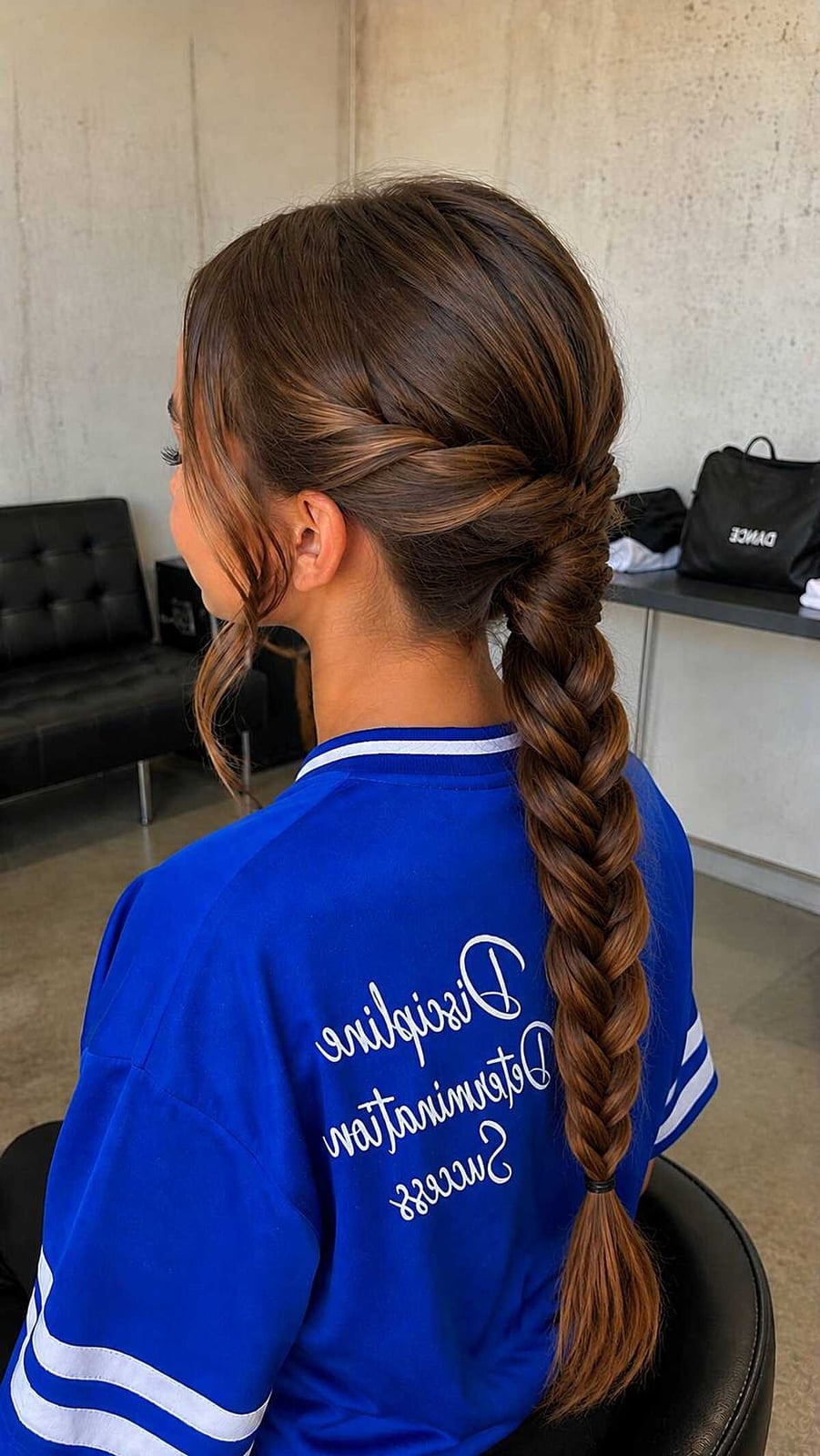
A fishtail braid holds remarkably well through a dance because each strand locks into the one beside it, creating tension that resists slipping. The wavy texture of this dark brown hair adds grip, so the braid stays put without constant pinning. Subtle lighter highlights catch the movement, making the pattern visible even from the back of a stage. Ask your stylist for: intricate fishtail braid. To keep the shape defined, separate the two sections evenly and pull each strand across with the same tension. The middle parting keeps the top smooth, which helps the braid sit centered. Over a few hours, the braid may soften slightly at the crown, but the woven structure means it rarely unravels. Mid-back length is ideal, since shorter hair tends to lose the distinct herringbone effect.
Medium Brown Waterfall Braid With Loose Waves
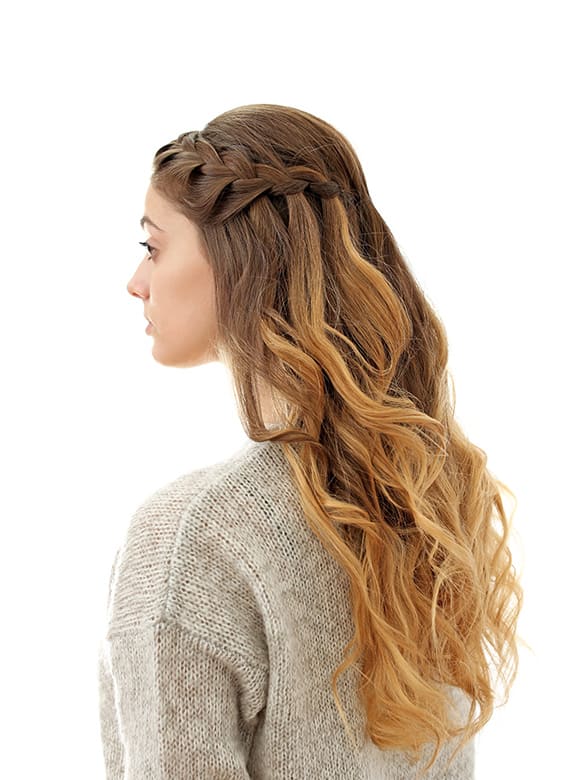
How do you describe a braid that lets most of your hair flow free? The waterfall braid weaves across the top, then drops strands to cascade down, which is exactly what you want if you’re dancing but still want movement. The blonde balayage on this medium brown base gives the falling pieces a sunlit edge, so the braid reads clearly against the waves. Ask your stylist for: waterfall braid with loose waves. When you ask, specify the looseness: a tighter braid holds through a full routine, while looser strands give a softer, more romantic finish. The waves below are set with a large-barrel iron, and the middle parting keeps the front symmetrical. This one is salon-leaning because the braid needs an even hand to keep the dropped pieces consistent, but the payoff is a style that looks intricate without pinning everything up.
Long Blonde Waterfall Braid With Waves
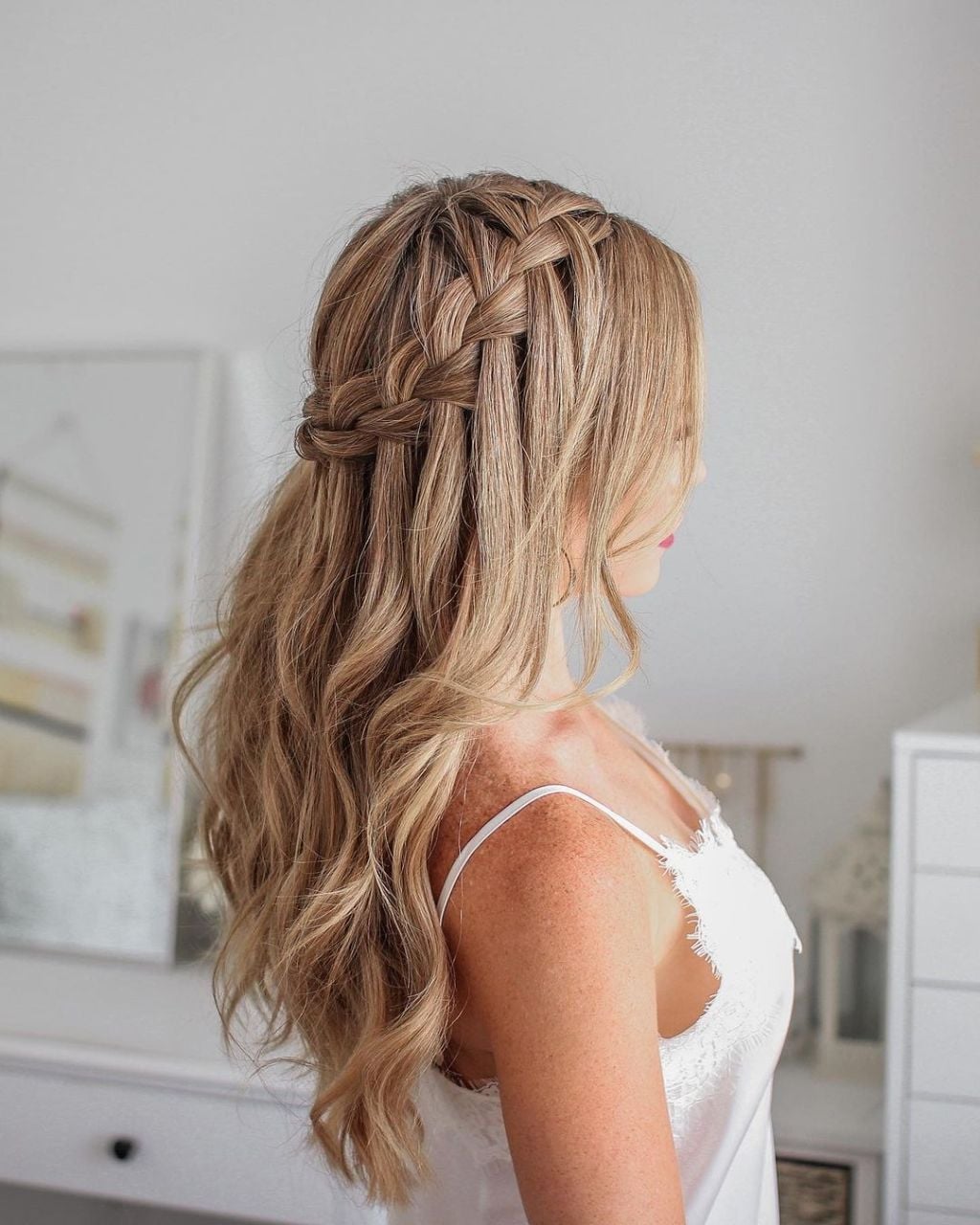
Compared to a shoulder-length version, a long waterfall braid has the advantage of weight and flow. The extra length lets the braid cascade without looking cramped, and the loose waves below carry the eye down, which suits medium-density hair that can handle the bulk. Face-framing pieces soften the front, so the braid doesn’t read as severe. Ask your stylist for: waterfall braid with loose waves and face-framing pieces. The uniform blonde color here keeps the focus on the braid’s structure, since there’s no contrast to distract the eye. On long hair, the braid sits lower, which means it stays intact through turns and jumps, but the ends can tangle if the waves aren’t set with a flexible hold spray. This is the version to choose when you want the braid to feel like part of the movement, not a constraint.
For a shorter waterfall braid, the effect is more contained and the braid tends to stay tighter at the crown. That version suits dancers who need every strand secured early. The long version offers more drama but requires a bit more maintenance between dances to keep the waves from frizzing.
Blonde Braids Into Low Ponytail
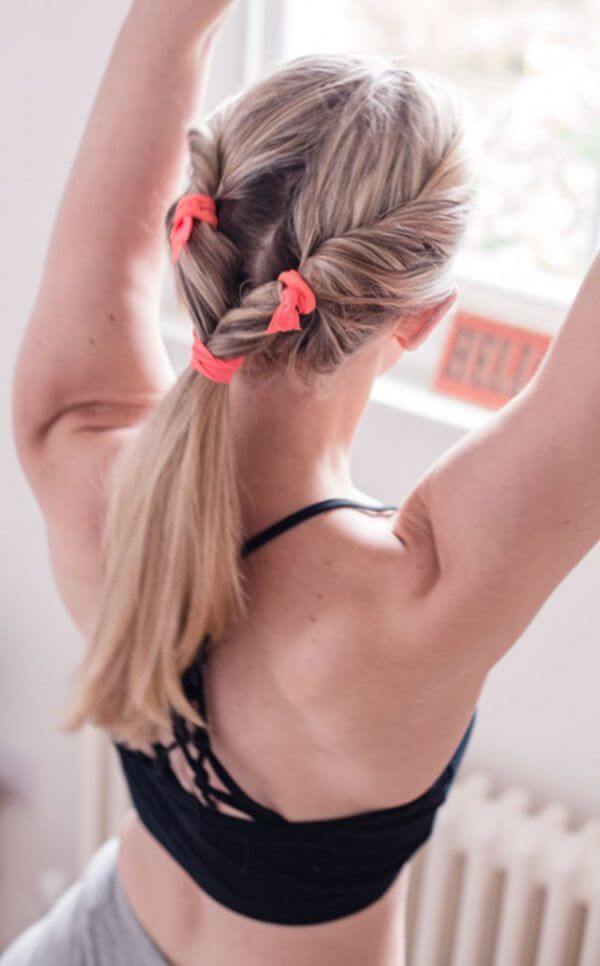
Two braids that converge into a low ponytail is a clever way to keep hair off your face without the bulk of a full braid. The fishtail detail adds texture, and the loose waves give the ponytail body, so it doesn’t look like a plain pull-back. Ask your stylist for: two braids into a low ponytail with fishtail detail. To do it at home, start by braiding the front sections on each side, then gather everything at the nape and secure with an elastic. The key is to keep the braids tight enough to hold, but not so tight they pull at the temples. This is a DIY-friendly option, since the braids don’t need to be perfect, and the low ponytail hides any unevenness. A few loose strands around the face soften the look, and the blonde highlights give the style a sporty, sun-kissed finish.
Ash Blonde Braided Half-Up With Loose Waves
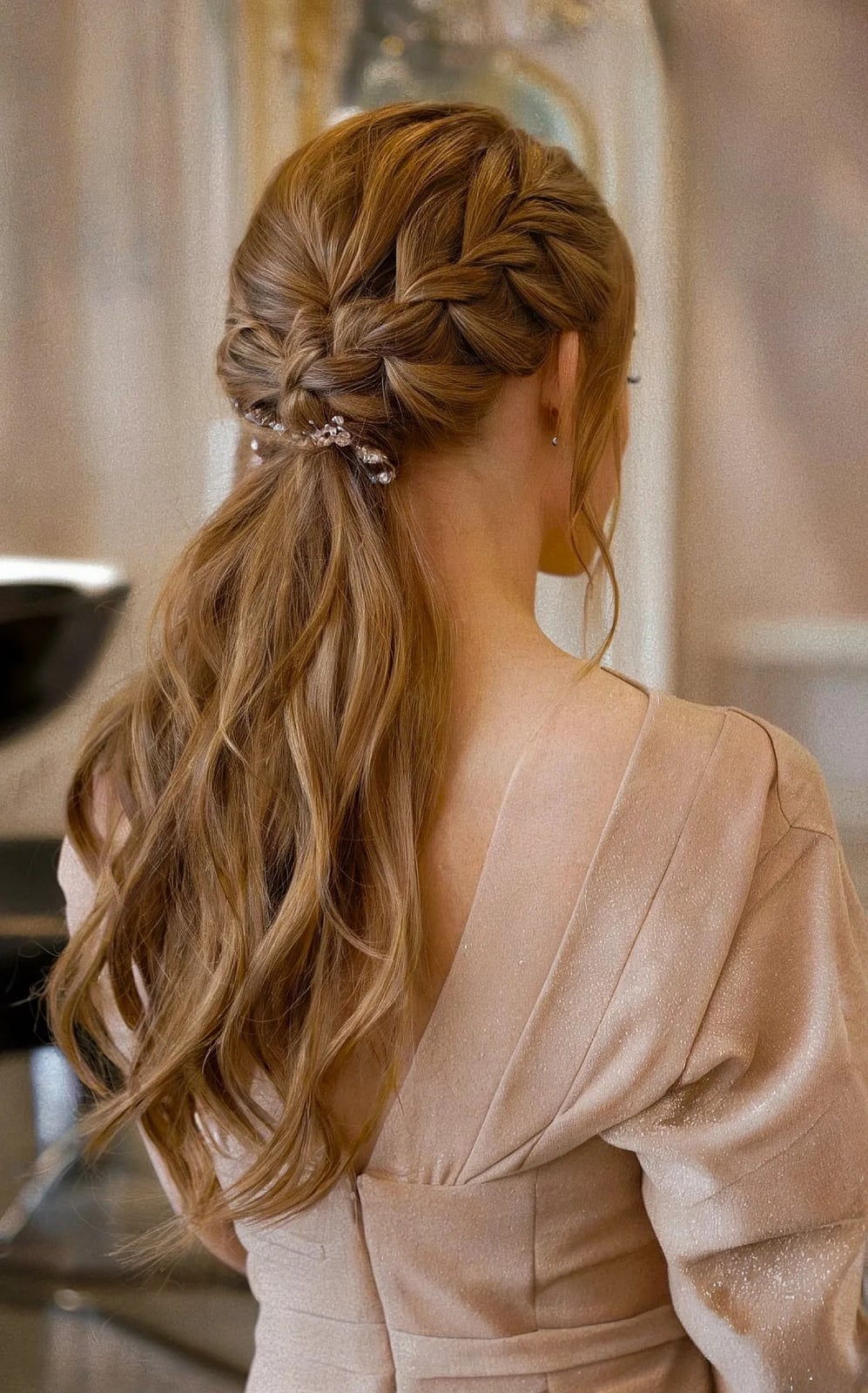
The intricate braid across the crown is built from a middle parting, with each section woven tightly before being pinned at the back, leaving the rest to fall in loose waves to mid-back. This ash blonde with highlights reads as dimensional, the lighter pieces catching the eye along the braid. It suits thick, wavy hair of mid-back length or longer, and most face shapes can wear it. Ask your stylist for: intricate braided half-up, half-down with loose waves. The braid holds well if the pins are anchored firmly, but the loose waves can soften by the end of a long performance, so a texture spray before styling helps.
Blonde Balayage Braided Crown Half Updo
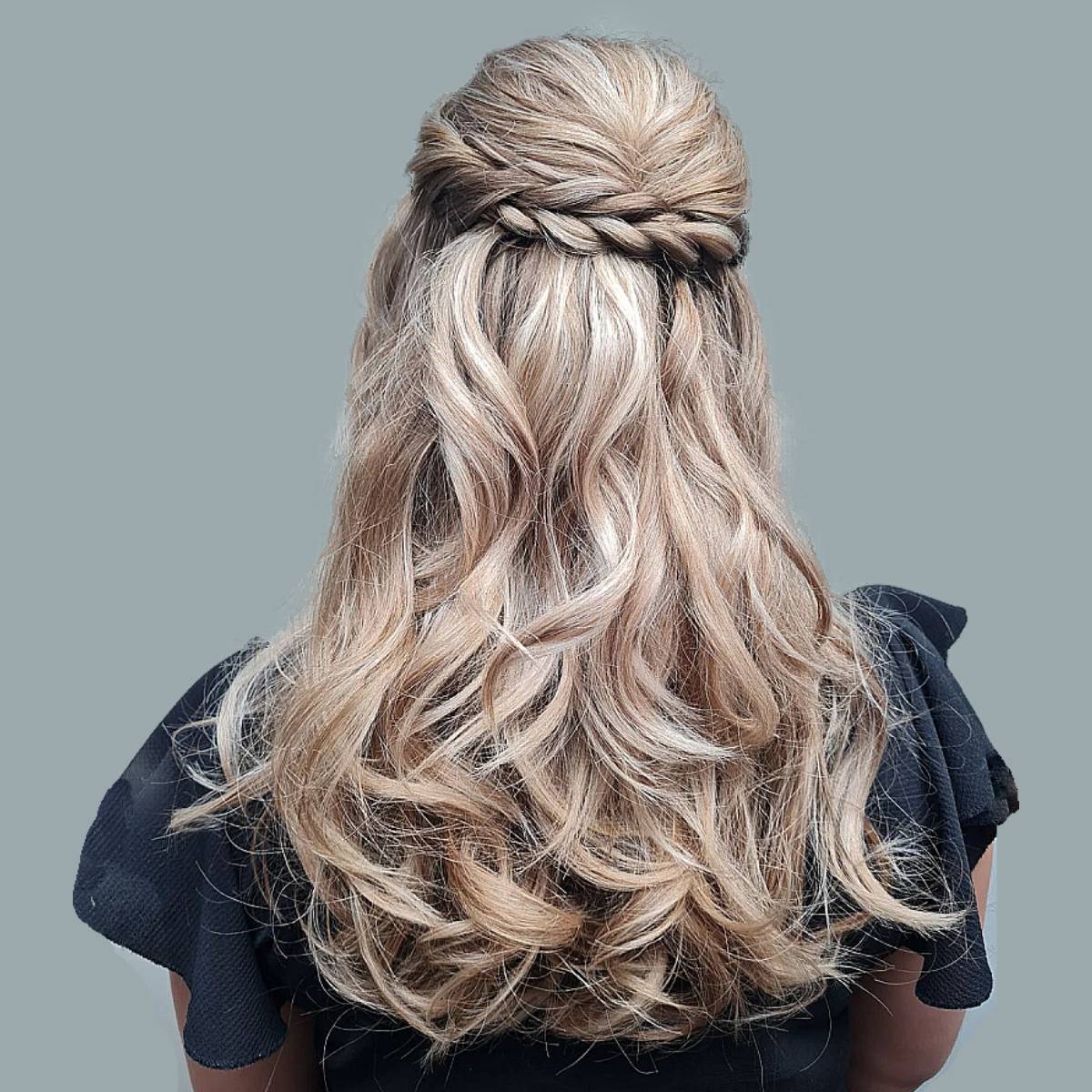
A blonde balayage braided crown works best when the color has enough contrast to define each twist, and this one has it: the lighter pieces trace the braid’s path while the deeper base keeps the waves grounded. It genuinely flatters medium density, wavy hair of mid-back length or longer, and the half-up shape suits most face shapes by balancing volume at the crown. Ask your colorist for: braided crown half-up style with waves. The braid must be tight enough to stay put, so pin any loose ends securely; the waves below move freely without pulling the crown out of place.
For a performance, this style reads as polished without being severe, the balayage adding depth that a single flat shade would not. It is a salon-leaning look, best built with clean sections and a firm hand.
Golden Blonde Curly Half-Up With Braid
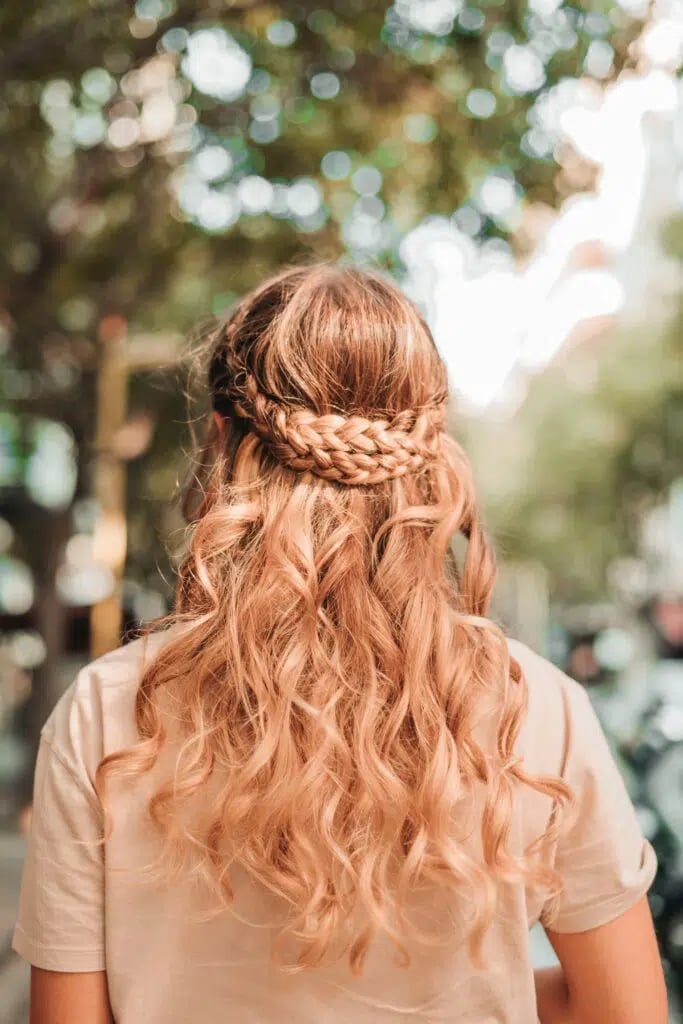
Can curly hair hold a half-up braid through a full rehearsal without slipping? Yes, with the right prep. This golden blonde with balayage starts with long, thick, curly hair, the braided crown pulling the top section back while the lower section falls in loose curls. Ask your stylist for: half-up, half-down with braided crown in curly hair. The hold comes from securing the braid at the crown with strong pins, but the curls below need a curl-defining cream and a diffuser to keep their shape and avoid frizz. The balayage highlights add dimension, so the braid does not disappear into the surrounding hair. The volume at the sides can overwhelm a very narrow face, so keep the crown braid snug and the sides lighter.
Upkeep is about moisture: curly hair in this style needs a hydrating conditioner to stay soft, and a trim every eight to ten weeks keeps the ends from splitting. The style holds for a few hours, but expect to refresh the curls with water and product before a second set.
Dark Brown Half Up Half Down With Twists
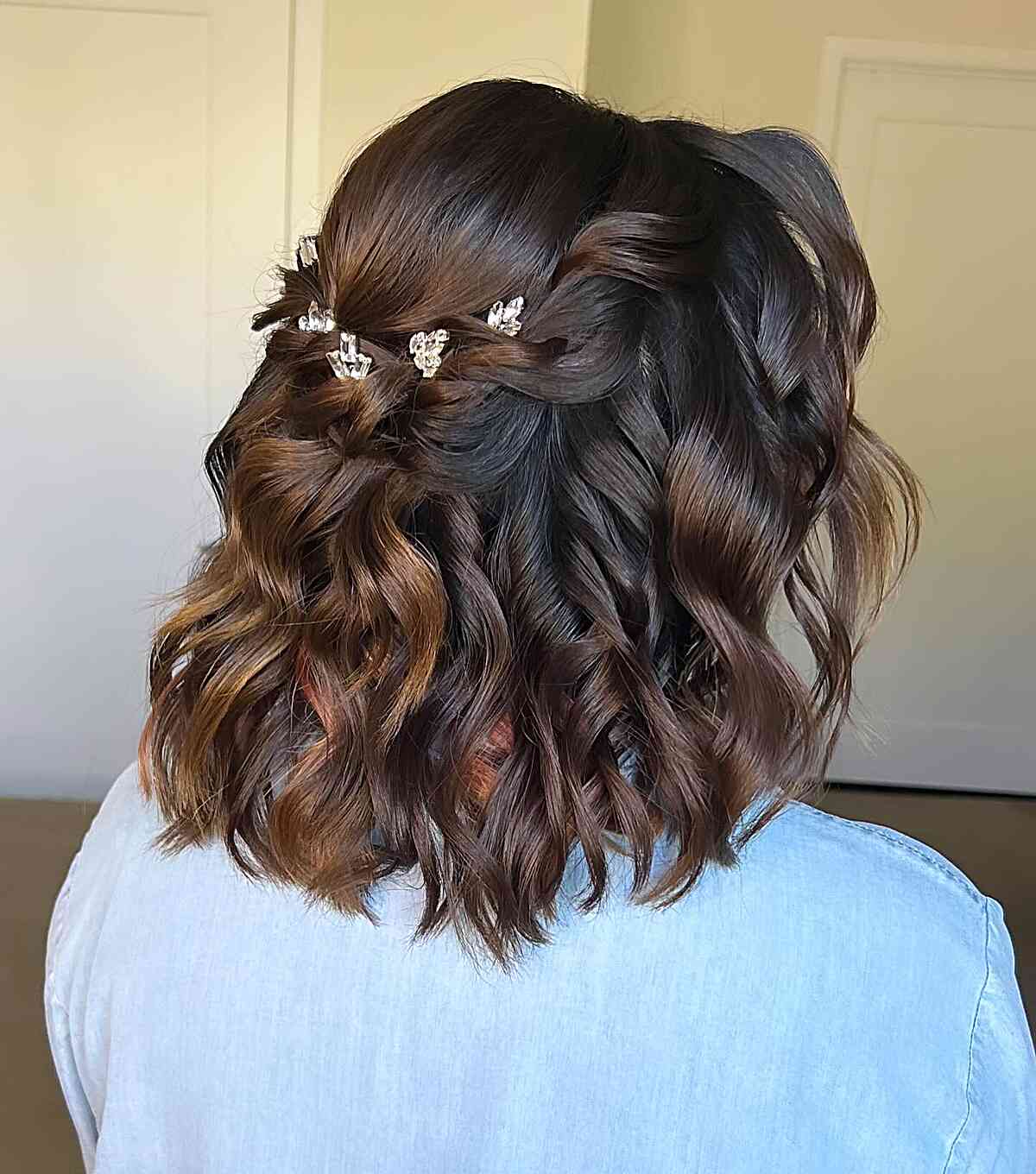
This dark brown with subtle highlights benefits from the clips doing double duty: they hold the twists and add detail. Ask your stylist for: half up half down with twisted sections and decorative clips. The twists should be small and even, starting at the temples and angling toward the back; the clips go at the meeting point, not too high, so the style reads as relaxed. It suits medium density, wavy hair of collarbone length or longer, and most face shapes, though a middle part elongates a round face. The hold is solid for a few hours, but the soft waves can loosen, so a texture spray on the lengths helps keep the shape.
Ash Blonde Chunky Braid
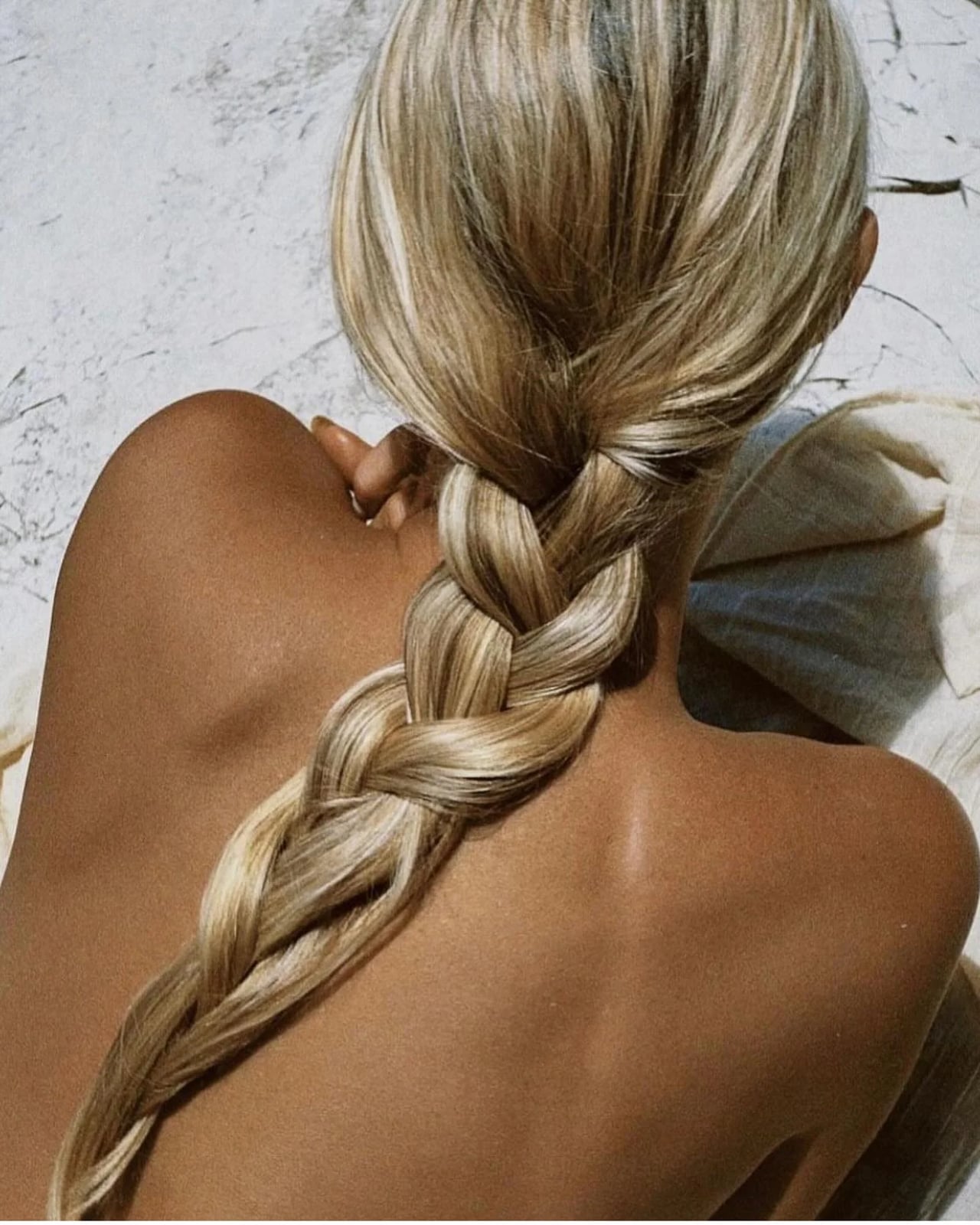
A chunky braid starts with a middle parting and a thick section at the nape, woven loosely so the ash blonde highlights show through. To get this at home, tease each section before braiding to add bulk, then pull the edges of the braid gently outward as you go. Ask your stylist for: thick chunky braid. The result is a fuller braid that holds well for a full day, though the top can loosen if you do not pin the base. This is a DIY-friendly style for thick, wavy hair of mid-back length. It is faster than a salon visit and easy to redo mid-event.
Dark Brown Ponytail With Intricate Braid Base
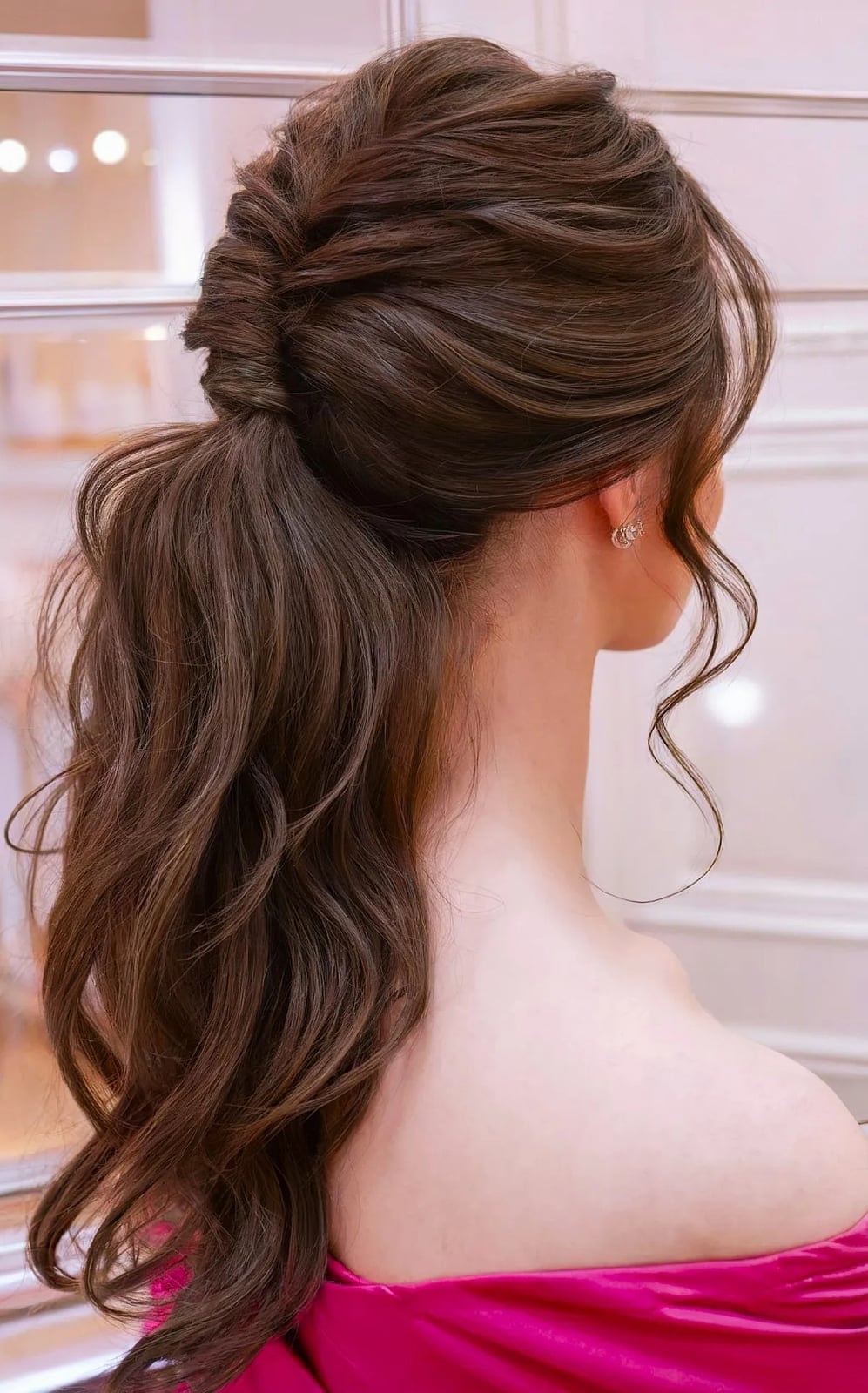
Thick, wavy dark brown hair falls to mid-back with subtle lighter strands, all gathered into a ponytail. The real trick here is the braid wrapped around the base, which hides the elastic and gives the whole thing a finished feel. Anyone with medium to thick hair of at least mid-back length can pull this off. Ask your stylist for: a high ponytail with intricate braid around the base. The drawback is that the detail takes time to place precisely, so this is not a five-minute style. A strong-hold hairspray keeps the braid from loosening during the first set.
Dynamic Dark Brown Wavy High Ponytail
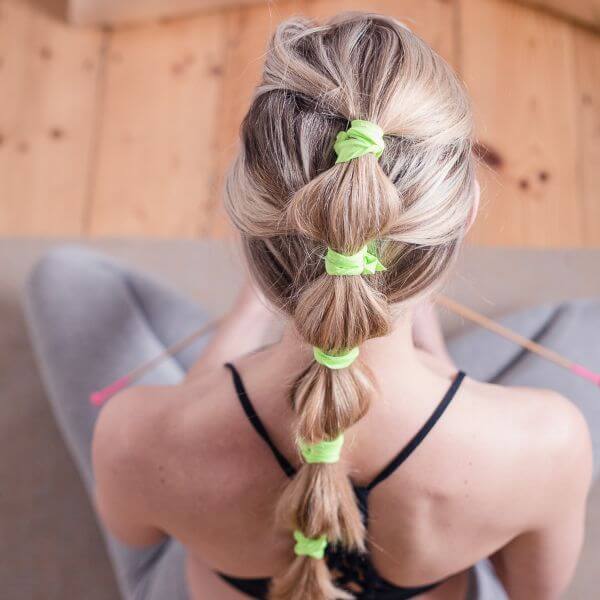
A sleek, flat-ironed high ponytail looks sharp and controlled. This one does the opposite. The dark brown hair is thick and wavy, swept up with a side part that gives it a directional, moving quality. The subtle lighter tones keep the color from falling flat when the hair swings. Ask your stylist for: a dynamic high ponytail with wavy texture. Hair that already has some wave or bend holds this style well. A texture spray applied before pulling the hair up adds grip without weighing down the movement.
Long Blonde Low Ponytail With Twisted Detail
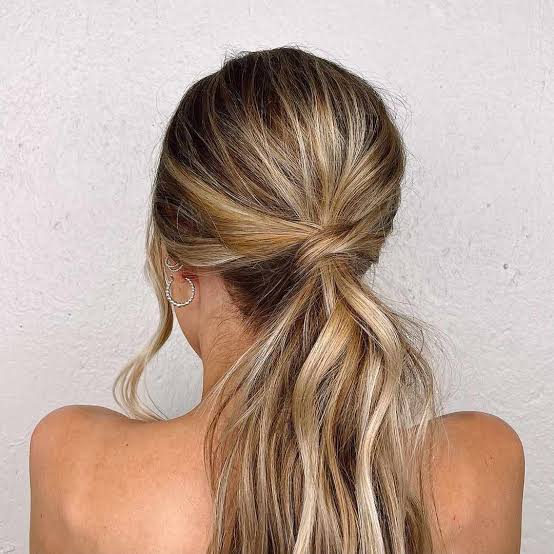
Long blonde hair with soft highlights falls in loose waves to a low ponytail set at the nape. A twisted section of hair wraps the base, creating a polished detail without needing a full braid. This is a good option for hair with medium density and some natural wave, as the texture gives the twist more body to work with. Ask your stylist for: a low ponytail with twisted detail. The side part helps the length appear styled and deliberate.
Those with very fine or slippery hair may find the twist loosens during active movement. A few extra bobby pins and a light mist of hairspray are worth the insurance. The style looks salon-done but takes under ten minutes once you have the motion down.
Honey Blonde Low Bun With Decorative Clip
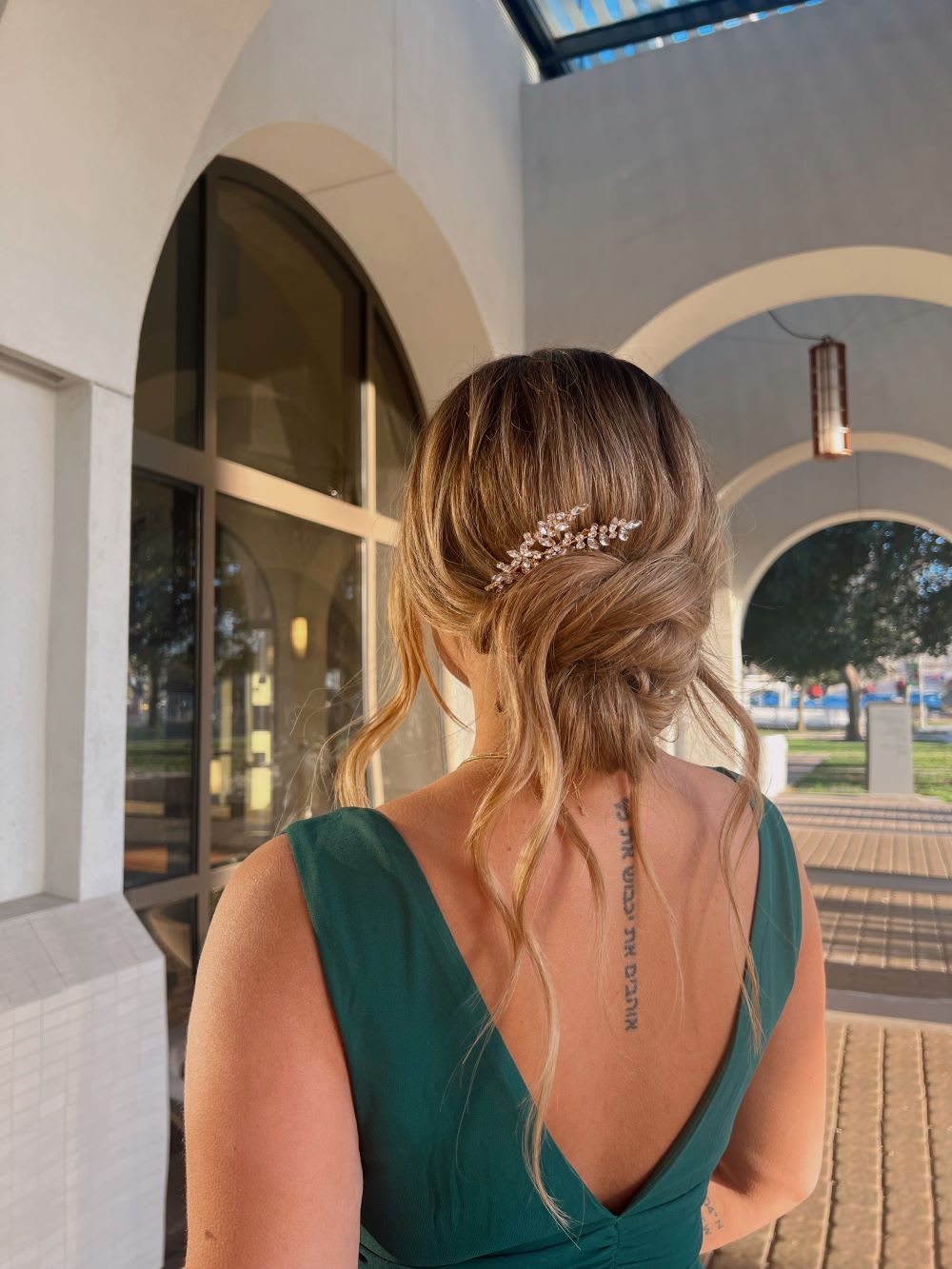
A low bun sits at the crown line with soft waves spilling down the back and wispy pieces breaking around the face. The honey blonde base has subtle highlights that add dimension without looking striped. A jeweled clip placed on the side of the bun provides the focal point. Ask your stylist for: a low bun with loose waves and decorative clip. The clip does double duty as a style accent and a way to secure the bun.
Upkeep involves refreshing the waves with a light curl spray between uses and retightening the clip if it shifts. The style holds well through rehearsal runs but may need a pin check before the final bow.
Neat Blonde Bun With Subtle Highlights
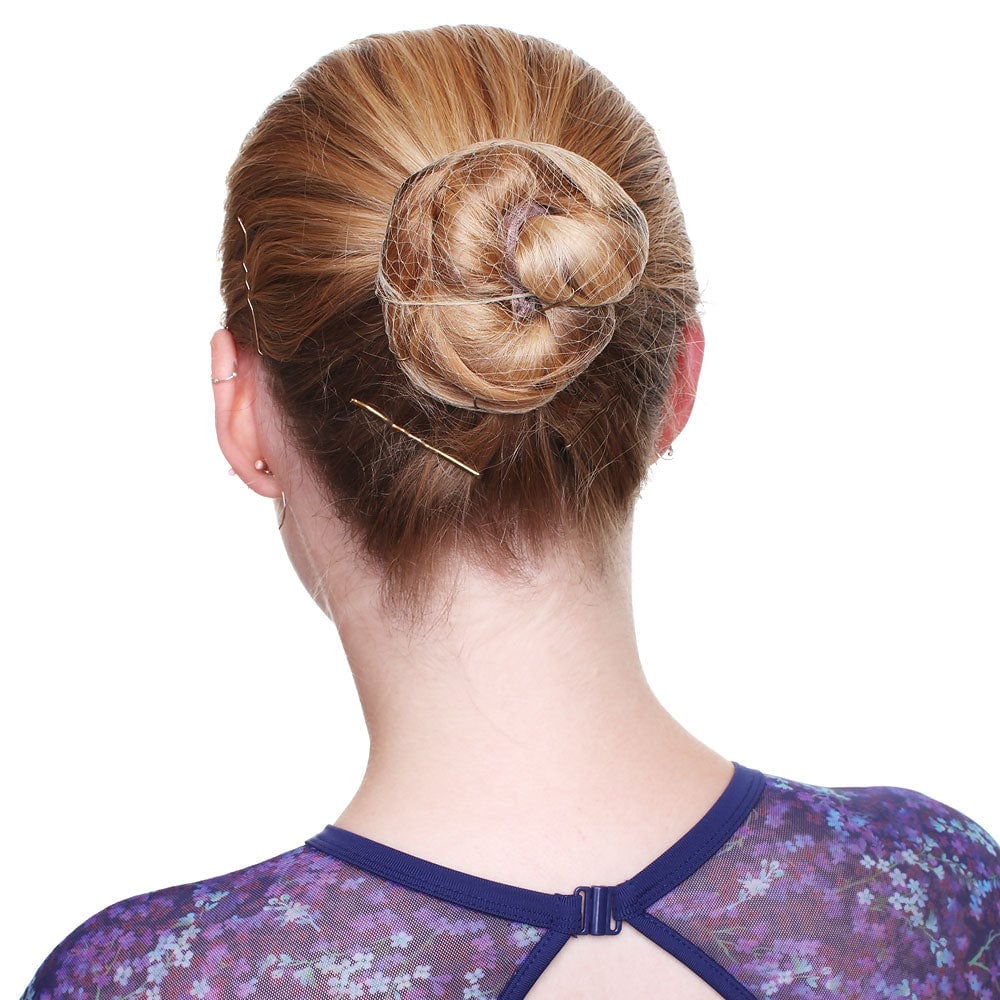
Can a bun be too neat? For dancers, the answer is almost never. This one sits at the back of the head, built from thick, straight mid-back-length blonde hair with subtle highlights woven through. Every strand is smoothed into place with no visible parting, which means flyaways will announce themselves loudly. A smooth bun like this one takes practice to get right on yourself. Ask your stylist for: a neat, secure bun.
The honest trade-off is that a look this clean is harder to achieve on your own than a textured bun. If you have fine or slippery hair, the bun may need extra pinning and a strong-hold spray to stay compact through a full routine. For competition or stage, the polish is worth the extra time in the mirror.
Final Thoughts
For maximum security during intense routines, opt for tightly braided styles or buns secured with ample pins and hairspray. For less demanding performances, looser waves and face-framing pieces add style without the fuss.
- Secure buns and ponytails with strong-hold hairspray for extended wear.
- Braid hair while damp to encourage texture and reduce flyaways.
- Use clear elastics and bobby pins that match your hair color for a seamless look.
- Allow braids to set overnight for deeper texture, or style just before performance.
- Trim split ends every 6-8 weeks to keep styles smooth and manageable.
Dance your heart out with a style that stays put.
